
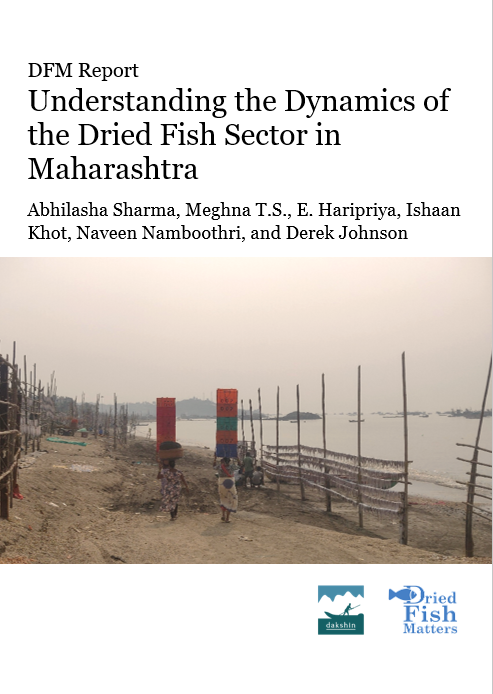
The Dried Fish Matters (DFM) project is pleased to share the publication of Understanding the Dynamics of the Dried Fish Sector in Maharashtra, a report prepared by Abhilasha Sharma, Meghna T.S., Haripriya E., Ishwari Khot, Naveen Namboothri, and Derek Johnson in collaboration with Dakshin Foundation, one of DFM’s key research partners in India.
Maharashtra is one of India’s leading marine fisheries states and has a long history of dried fish production. Species such as Bombay duck, ribbonfish, anchovies, and prawns support a vibrant dried fish economy that sustains fishers, processors, traders, transporters, and retailers across the state. Despite its economic, cultural, and nutritional significance, the sector has often remained overlooked in both fisheries research and policy. This report seeks to address that gap by documenting the dynamics, opportunities, and challenges that characterize Maharashtra’s dried fish value chain.
Drawing on field research conducted across seven coastal districts, the report maps the structure of dried fish production and trade while examining the social, economic, and ecological relationships that sustain the sector. The findings reveal the diversity of actors involved in dried fish value chains and the complex pathways through which dried fish moves from landing centres to local, regional, and national markets.
A central contribution of the report is its focus on labour and gender. Women play a critical role in processing, sorting, drying, marketing, and trading dried fish, yet their contributions frequently remain invisible in formal statistics and policy discussions. The report highlights the need for greater recognition of women fishworkers and calls attention to the importance of supporting their livelihoods, working conditions, and participation in decision-making processes.
The study also examines emerging pressures facing the sector, including environmental change, fluctuations in fish availability, market transformations, and the growing diversion of small fish to non-human uses such as fishmeal and poultry feed production. These trends have significant implications for livelihoods, nutrition security, and the sustainability of coastal food systems, particularly for communities that depend on dried fish as an affordable and accessible source of protein and micronutrients.
Beyond its immediate findings, the report reflects Dakshin Foundation’s longstanding engagement with small-scale fisheries and coastal communities in Maharashtra. For many years, Dakshin Foundation has worked alongside fishing communities through research, conservation initiatives, and community-based engagement, generating a deep understanding of the social and ecological dimensions of fisheries. This embeddedness is evident throughout the report. Rather than viewing dried fish simply as a commodity, the study situates it within the broader realities of coastal life, examining how livelihoods, food cultures, gender relations, ecological change, and community well-being intersect within the dried fish economy.
This perspective closely aligns with the objectives of the Dried Fish Matters project. DFM seeks to make visible the often-overlooked contributions of dried fish to food security, livelihoods, gender equity, and sustainable development. By documenting the experiences of fishworkers and value chain actors, the report advances DFM’s commitment to understanding the social economy of dried fish and strengthening recognition of the sector within policy and development agendas. The findings also contribute to DFM’s broader efforts to explore the connections between human rights, nutrition security, climate and environmental change, and the governance of small-scale fisheries.
Importantly, the report demonstrates that dried fish is far more than a secondary fisheries product. It is a vital component of coastal economies, cultural traditions, and food systems that supports thousands of households across Maharashtra. At a time when coastal communities face increasing environmental, economic, and social pressures, understanding and supporting the dried fish sector is essential for building more inclusive and resilient futures.
The Dried Fish Matters project congratulates the authors on this important contribution to advancing knowledge about Maharashtra’s dried fish sector and its role in sustaining livelihoods, nutrition, and coastal resilience.
The report is available here.