
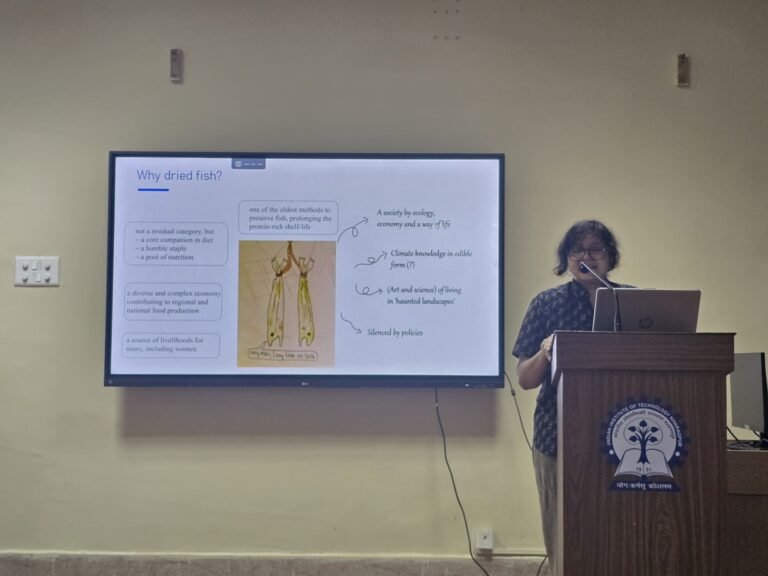
The Dried Fish Matters (DFM) team is delighted to celebrate the successful PhD defence of Ms. Raktima Ghosh from the Indian Institute of Technology Kharagpur, West Bengal – India.
Completed under the supervision of Dr. Jenia Mukherjee, Raktima’s dissertation, Wet Side of Dried Fish: Centring Relations and Rights in the Social Economy of Dried Fish in the Indian Sundarbans, offers an important contribution to understanding fisheries livelihoods, governance, gender, and rights within one of the world’s most climate-vulnerable deltaic regions.
Reflecting on her work, Raktima writes: My research focuses on the ‘social economy’ of dried fish in the Indian Sundarbans, a highly politicised and climate-vulnerable deltaic region. Through ethnographic fieldwork and visual methods, the study explores how fish drying is embedded in social relational processes, with particular attention to place-based livelihood practices and gender. The study also centres fishworkers’ activism and their struggle for rights. It argues that the movement’s imperative does not emerge in vacuum; it is a direct response to an opaque governance and policymaking from the ‘above’. The findings of my research foreground that fish drying is not a ‘residual’ or ‘backyard’ activity in fisheries, but a vital and thriving economy where labour, ecology, food, and identity are deeply intertwined.
The dissertation strongly resonates with DFM’s broader commitment to understanding dried fish value chains through the lenses of social economy, justice, gender, livelihoods and governance. By centering ethnographic insights and fishworkers’ lived experiences, the research contributes meaningfully to ongoing conversations surrounding rights, visibility and equitable fisheries governance in South Asia.
Raktima also reflected on the collective relationships and mentorship that shaped her doctoral journey: This research is a contribution to the Dried Fish Matters (DFM) project. I remain deeply grateful for the relationships it has brought to me and contributing to the very foundation of my work. I am especially thankful to Dr. Jenia Mukherjee and Dr. Amrita Sen for their guidance and consistent faith in my research. My work has benefitted immensely by the insights and thoughtful suggestions of Dr. Derek Johnson – my heartfelt gratitude goes to you. I would like to thank all the remarkable researchers of the DFM project.
The DFM team warmly congratulates Dr Raktima Ghosh on this remarkable achievement and looks forward to the continued contributions of her work to scholarship and policy discussions on fisheries, gender, governance, and climate-vulnerable livelihoods.