
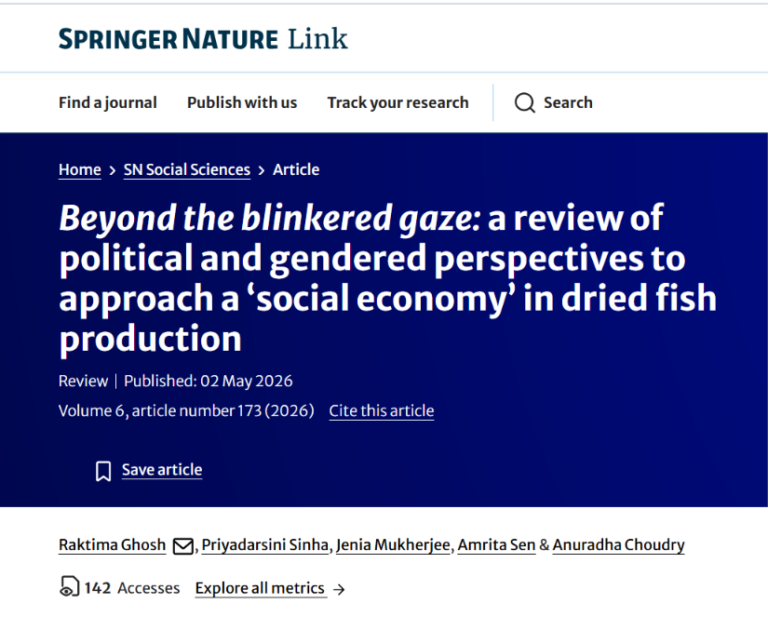
The Dried Fish Matters (DFM) project is pleased to share a new publication that advances our understanding of dried fish beyond conventional economic analyses. Published in SN Social Sciences, the article, Beyond the Blinkered Gaze: A Review of Political and Gendered Perspectives to Approach a ‘Social Economy’ in Dried Fish Production, offers a comprehensive review of the social, political, and gendered dimensions of dried fish production across South and Southeast Asia.
The article is authored by Raktima Ghosh, Priyadarsini Sinha, Jenia Mukherjee, Amrita Sen, and Anuradha Choudry from the Indian Institute of Technology Kharagpur. The publication is a major contribution to the Dried Fish Matters project and builds upon years of research examining dried fish as a livelihood, food system, and cultural practice.
Drawing on a systematic review of 168 academic and grey literature sources, the authors examine dried fish production through the lens of social economy, an approach that recognizes that economic activities are deeply embedded within social relationships, cultural values, institutions, and power structures. The review brings together insights from political ecology, gender studies, and social economy scholarship to better understand the diverse realities of dried fish production in the region.
A key contribution of the paper is its challenge to narrow, market-centred interpretations of fisheries economies. The review demonstrates that dried fish production is not simply a commodity chain driven by profit and market exchange. Instead, it is shaped by networks of reciprocity, kinship, care, customary institutions, collective action, and everyday negotiations over access to resources and livelihoods. These social dimensions are particularly important in small-scale fisheries, where dried fish often serves as a crucial source of food security, income generation, and cultural identity.
The authors also highlight the central role of gender in dried fish economies. Across South and Southeast Asia, women undertake significant responsibilities in processing, trading, marketing, and household management, yet their contributions often remain undervalued or invisible in policy and research. By synthesizing evidence from multiple countries, the review reveals how gender relations influence access to resources, labour opportunities, decision-making processes, and livelihood outcomes throughout dried fish value chains.
The paper further demonstrates how political and institutional factors shape dried fish production. Issues such as governance arrangements, environmental change, fisheries policies, labour relations, and access rights all influence the opportunities and constraints faced by fishworkers and processors. In doing so, the review connects dried fish production to broader debates on justice, equity, and sustainability within contemporary blue economy discussions.
Importantly, the publication aligns closely with the objectives of the Dried Fish Matters project. Since its inception, DFM has sought to move beyond purely technical or economic understandings of dried fish by documenting the ways in which dried fish contributes to livelihoods, nutrition, culture, gender relations, and community wellbeing. The review provides a valuable synthesis of existing knowledge while identifying important directions for future research, policy development, and practice.
By foregrounding the social economy of dried fish, this publication reinforces a central message emerging from DFM research: dried fish is far more than a commodity. It is a vital socio-economic and cultural system that sustains millions of people across South and Southeast Asia and deserves greater recognition within fisheries governance, development planning, and blue economy initiatives.