
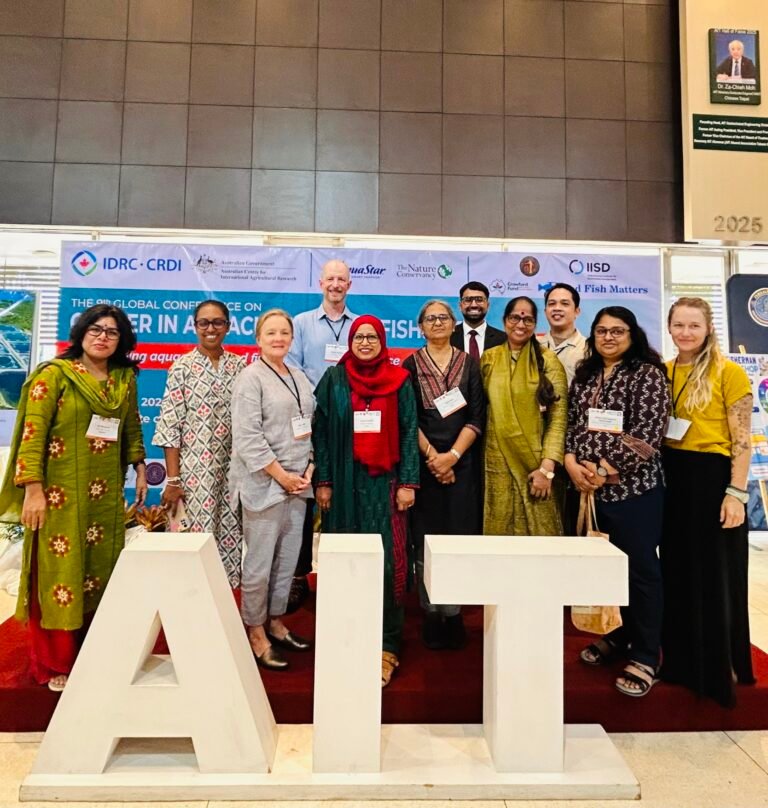
Dried Fish Matters (DFM) brought its research on gender and dried fish economies to the 9th Global Conference on Gender in Aquaculture and Fisheries (GAF9), held from 1–3 October 2025 at the Asian Institute of Technology in Pathum Thani, Thailand. The conference theme, “Transforming Aquaculture and Fisheries for Gender Justice,” provided a forum for examining the inequalities that shape women’s work across aquatic food systems.
A central part of DFM’s participation was the special session “Gender Dynamics in Social Economies of Dried Fish in South and Southeast Asia,” held on 3 October. Across morning and afternoon sessions chaired by Kyoko Kusakabe and Derek Johnson, researchers explored women’s livelihoods, working conditions, and opportunities to exercise agency in dried fish production and trade.
Derek Johnson introduced DFM Working Group 1’s collaborative synthesis on gender, social economy, and the making of dried fish in Asia. Drawing together research across the project, the presentation highlighted women’s central role in processing and the varied social and economic constraints they face. It also connected the session to a synthesis paper and edited volume in development, showing how individual studies contribute to a wider regional analysis.
The contributions brought these questions into specific places and experiences. Jessie Varquez examined women’s artisanship in making boneless danggit, or dried rabbitfish, in the Philippines. Colleen Cranmer explored changing livelihoods among female fish processors at Cambodia’s Tonle Sap, while Gayathri Lokuge and Nadiya Azmi examined how access to market spaces and social relationships shape fish trading in Negombo and Phnom Penh.
Safina Naznin’s research addressed gender roles and occupational health risks among women processing dried fish in Nazirartek, Bangladesh. Aklima Akter explored women’s agency through the concept of “patriarchal bargaining,” examining how women negotiate their interests within unequal gender relations.
Research from India connected these concerns to capabilities, policy, and human rights. Jeena T. Srinivasan examined the capabilities of women processors in Andhra Pradesh’s informal dried fish economy. Tara Nair examined the policy landscape shaping gender relations in dried fish value chains. Mohammad Anas Shoebullah Khan presented research from Valsad, Gujarat, showing how mapping gendered work and social relationships can inform a human rights-based approach to small-scale fisheries.
DFM’s contributions also extended to the wider conference. Holly Hapke delivered the opening keynote, calling attention to women’s undervalued unpaid and informal labour and the ways class, caste, age, and identity shape their opportunities. DFM collaborators Kyoko Kusakabe and Nikita Gopal also contributed to conference leadership as the current and former chairs of the Gender in Aquaculture and Fisheries Section of the Asian Fisheries Society, respectively.
The special session reflected DFM’s collaborative approach to producing knowledge. Bringing researchers at different career stages into a shared discussion connected detailed fieldwork with comparative questions about gender and social economy, and provided a forum for developing the project’s collective outputs.
A further highlight was Jessie Jr Varquez’s Best Photo Prize. His winning photograph, produced as part of DFM, documents the work of arranging fish on a drying rack on Bantayan Island in the Philippines, drawing attention to the extreme heat women face at work. The award recognized visual storytelling that makes women’s labour and working conditions visible alongside the project’s written research.