
The Dried Fish Matters (DFM) project has reached an important milestone as we mark the midpoint of our seven-year Partnership Grant, funded by the Social Sciences and Humanities Research Council of Canada (SSHRC). As part of our midterm reporting exercise, we took the opportunity to reflect on the project’s achievements, emerging research findings, and the collaborations that have shaped our work over the past three years.
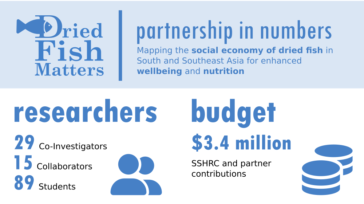
With more than 100 students, collaborators, and co-investigators working across over 30 partner organizations, DFM has grown into an international research partnership dedicated to understanding the economic, nutritional, social, and cultural significance of dried fish. Despite the considerable challenges posed by the COVID-19 pandemic, our research teams have continued to advance collaborative research, share knowledge, and strengthen connections across South and Southeast Asia and beyond. Over the first half of the project, DFM partners have contributed to a range of research and knowledge mobilization activities. These include the production of audiovisual materials exploring the cultural and sensory dimensions of dried fish, alongside participation in international virtual events such as the World Ocean Week Small-Scale Fisheries Open House and the 2021 MARE “People and the Sea” Conference.

Collaborative work is also underway on a collectively authored e-book and a digital humanities exhibition, bringing together research and creative approaches to communicate the importance of dried fish to wider audiences. Our research has generated important insights into the changing dynamics of dried fish economies across the region, helping identify priorities for the second half of the project.
Among the emerging findings:
- Sri Lanka: Dried fish production is expanding, but corresponding investments in supply chain management and value addition have not kept pace.
- Karnataka, India: The growing fishmeal industry is diverting fish away from human consumption, raising concerns about food and nutrition security.
- Bay of Bengal: Research has identified significant microplastic contamination in dried fish, highlighting potential concerns about food safety.
- Andhra Pradesh, India: Research suggests a disruption in the intergenerational transmission of women’s participation in dried fish processing, raising important questions about changing livelihoods and traditional knowledge.
Our research has also documented the deep cultural significance of dried, smoked, and fermented fish in communities around the world. A comprehensive review of the global literature further reinforces the importance of DFM’s research agenda, revealing substantial gaps in existing academic and applied research, particularly concerning social relations, cultural values, and food and nutrition security. As we enter the second half of the project, these findings will help guide our research priorities and deepen our understanding of the challenges and opportunities facing dried fish economies.
The achievements of the first three years reflect the dedication and collaborative efforts of researchers, students, and institutional partners across the DFM network. We extend our sincere appreciation to everyone who has contributed to the partnership, particularly through the unprecedented challenges of the pandemic.