

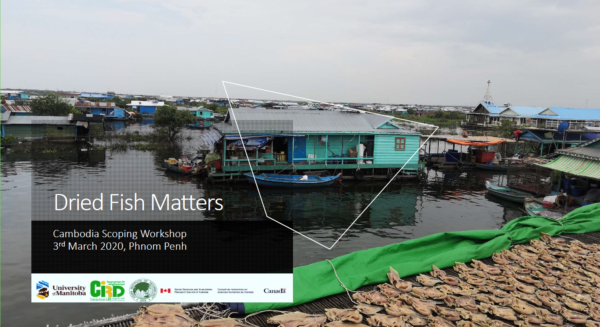
The Dried Fish Matters (DFM) Cambodia research team organized a stakeholder workshop in Phnom Penh on March 3, 2020, marking a significant milestone as Cambodia became the first DFM country team to complete its scoping research. The workshop brought together researchers, fish processors, government officials, private sector representatives, and development organizations to validate the emerging research findings and identify priorities for the next phase of the project.
Coordinated by the Cambodian Institute for Research and Rural Development (CIRD) in collaboration with the Centre for Poverty Analysis (CEPA), Sri Lanka, the workshop served as a concluding stakeholder consultation for Cambodia’s scoping research, which began in October 2019.
Sharing Findings from Cambodia’s Scoping Research
The workshop opened with remarks from Prak Sereyvath of CIRD, followed by an introduction to the broader DFM project by Derek Johnson from the University of Manitoba. Kyoko Kusakabe from the Asian Institute of Technology outlined the research methodology, while Gayathri Lokuge, who coordinated the Cambodia scoping research, presented its preliminary findings.
The scoping study combined extensive literature reviews and secondary data analysis with field research involving fishers, processors, traders, and fisheries experts across Cambodia. Research activities included key informant and semi-structured interviews, market observations, and surveys, with particular attention to Phnom Penh’s Orussey Market, a major wholesale centre for processed fish. The findings highlighted the diversity and significance of Cambodia’s dried and processed fish economy, including traditional products such as prahok (fermented fish paste), salted and sun-dried fish, smoked fish, and other fermented products. The research examined four interconnected themes: economy, food culture and nutrition, sustainable development, and governance.
Validating Findings Through Stakeholder Engagement
A central component of the workshop was an interactive World Café session, allowing participants to reflect on the scoping findings, identify knowledge gaps, and propose areas requiring further investigation. Discussions highlighted challenges including declining fish stocks, food safety and quality concerns, limited access to capital and technology, changing consumer preferences, and environmental pressures on fisheries-dependent livelihoods.
The participation of fish processors from six Cambodian provinces, many of them women, was particularly important in grounding the discussions in their lived experiences and the practical challenges facing small-scale processing and trading activities. Building on these discussions, participants identified three broad priorities for further research: strengthening processed fish value chains, improving collaboration among stakeholders, and supporting adaptation to social, economic, and environmental change.
Building on the Scoping Research
The workshop provided an important opportunity to consider how the findings could inform the next phase of DFM’s research in Cambodia. Potential directions included a greater focus on small-scale and home-based processors, changing market and consumption patterns, the role of aquaculture, and the impacts of climate and environmental change. Discussions also explored opportunities for applied initiatives, including improving product quality, strengthening market access, and exploring geographical indication certification for traditional products such as prahok.
As the first DFM country team to reach the concluding stage of its scoping research, DFM Cambodia provided an early foundation for moving from exploratory research toward more focused investigations and potential interventions. The stakeholder workshop helped consolidate emerging findings, strengthen relationships with local institutions and stakeholders, and identify research priorities grounded in the experiences of those directly involved in Cambodia’s dried and processed fish economy.
Read the full report of the Phnom Penh workshop here.