
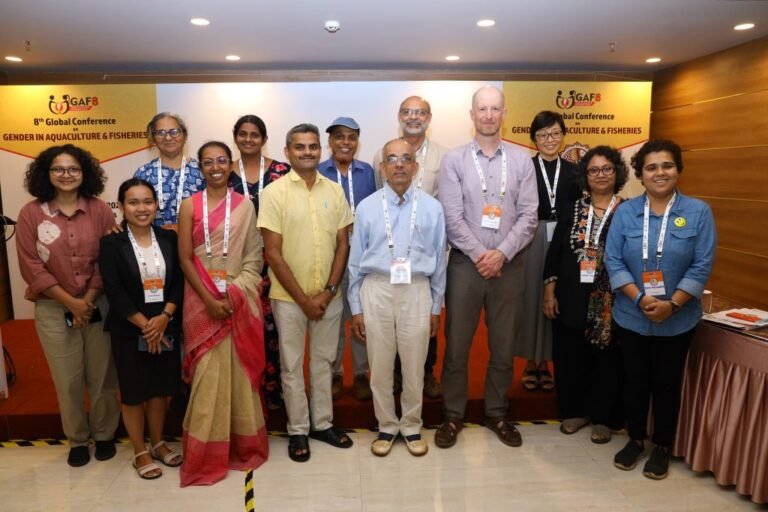
In November 2022, Dried Fish Matters (DFM) researchers participated in the 8th Global Conference on Gender in Aquaculture and Fisheries (GAF8) in Kochi, India. Through three panels on gender and the social economies of dried fish, the team shared research on the roles, experiences and working conditions of people involved in dried fish value chains across South and Southeast Asia.
The panels brought together 15 presentations, beginning with two that introduced approaches to understanding gender within the DFM project. The remaining presentations explored cases from Bangladesh, Sri Lanka, India, Myanmar and Cambodia. Together, they offered an opportunity to compare how gender shapes work and livelihoods across different dried fish economies.
Highlights from the panels were featured in the December 2023 issue of Yemaya, the International Collective in Support of Fishworkers’ newsletter on gender and fisheries. The article, “The Gendered Economy of Dried Fish,” was authored by Derek Johnson, Nikita Gopal, Kyoko Kusakabe, Tara Nair and Mirza Taslima Sultana.
Making women’s work visible
The presentations showed that women contribute to dried fish economies in many ways, particularly through processing and small-scale trade. Men were generally more prominent in harvesting and in larger-scale processing and trade. These patterns, however, varied across locations and communities.
For example, research from Sri Lanka highlighted how religious and ethnic differences can influence women’s involvement in dried fish activities. Such findings demonstrate why gender roles cannot be understood in isolation from the social and cultural contexts in which people live and work.
The panels also drew attention to inequalities in the conditions under which women and men work. Presenters described cases where women received lower wages, had less secure employment, and faced inadequate sanitation facilities. Women’s paid work was often accompanied by domestic and care responsibilities, adding to the demands on their time.
Looking beyond the value chain
The discussions at GAF8 highlighted the importance of examining dried fish economies through a gender perspective. Understanding who participates at each stage of a value chain is an important starting point, but it is also necessary to ask how access to resources, working conditions and opportunities are shaped by wider social relationships and power structures.
By bringing research from different regions into conversation, the DFM panels contributed to a more detailed understanding of women’s and men’s roles in dried fish economies and the inequalities they experience. This work supports the project’s broader aim of making the social, economic and cultural importance of dried fish more visible.
Read the article in Yemaya: The Gendered Economy of Dried Fish | Download the PDF