Social Economy

Working Group 1 - Social Economy

Working Group 1 (WG1) is conceptually and operationally the largest working group in DFM, and the working group that has had the most consistent record of meeting throughout the project.  

The mandate of WG1 is to coordinate research on the social economy aspects of dried fish within the project. We use social economy conceptually and descriptively. Conceptually, social economy is grounded in the heterodox economic argument that human economic relationships are influenced by a broad range of context-specific non-economic factors. Such influences include, but are not limited to, ecological (Pradhan et al. 2022), social, cultural, and historical (e-book). In the conceptual sense, our use of social economy draws on influences from a wide range of disciplinary and theoretical sources such as economic anthropology and geography, institutional economics, political economy and ecology, feminist theory, and critical approaches in international development studies. The concept of social wellbeing has played an important role in helping to frame the project’s social economic research. 

Descriptively, social economy provides the basis for addressing the foundational project objective of holistically ‘mapping’ social economies of dried fish in Asia and elsewhere. Initially, the project initially aimed to spatially map variables such as flows of dried fish using visual methods. That objective proved difficult to realize, and, instead, the project has come to engage in mapping through written and pictorial descriptions and analysis of dried fish production systems in different locations. Value chains and similar cognate approaches have proven extremely helpful for describing spatial patterns of dried fish production and exchange. As the project culminates, it is engaging in various efforts to look at commonalities and differences in social economies of dried fish across the Asian region. 

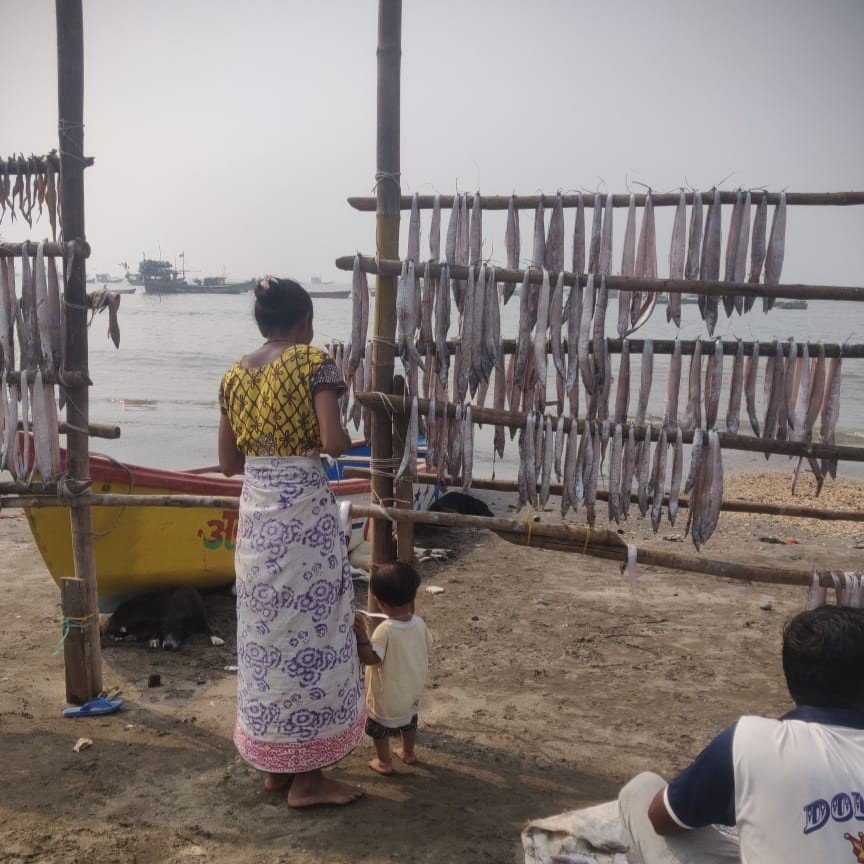
A particularly productive area of work within WG1 has been research on the place of gender within social economies of dried fish. Gendered analysis of dried fish social economies has strongly informed several of the project’s Research Teams and influenced numerous student research projects. That gender and social economies collaboration is currently at the forefront of DFM efforts to comparatively ‘map’ dried fish social economies across the region. 

Maharashtra_women_child photo 1

Woman fishworker with her child in a fish drying yard – Uttan, Maharashtra (Photo: Abhilasha Sharma)

Members & Contributors

Ben Belton

Fabiana Li

Eric Thrift

Ramachandra Bhatta

Gayathri Lokuge

Nireka Weeratunge

Ratana Chuenpagdee

Jenia Mukherjee

Kyoko Kusakabe

Kirit Patel

Deo Namwira

Nikitha Gopal

Alan Diduck

Prateep Nayak

Tara Nair

Sayeed Ferdous

Siddiqur Rahman

Raktima Ghosh

Holly Hapke

Mahmudul Sumon

Aklima Akter

Amalendu Jyotishi

Prasanna Surathkal

Colleen Cranmer

Dilanthi Koralagama

Mirza Taslima

Jessie Varquez

Mohammad Anas Shoebullah Khan

Jeena Srinivasan

Safina Naznin

Significant Publications:


  • Jyotishi, A., Bhatta, R., & Surathkal, P. (2024). The Dried Fish Processors of Karnataka (Working Paper No. 13; Dried Fish Matters). Azim Premji University / Snehakunja / The University of Manitoba. 
  • Khan, M. A. S. (2024). A Human Rights-Based Perspective on Dried Fish Value Chains in Gujarat, India [Master of Arts in Environmental and Social Change, University of Winnipeg]. https://doi.org/10.36939/ir.202408221619.
  • Nair, T., Patel, B., & Mishra, R. N. (2024). Trapped in a gulf of hope and despair: The Wagher small scale fisheries on the Kutch coast of Gujarat, India. Maritime Studies23(2), 17. https://doi.org/10.1007/s40152-024-00357-1
  • Thrift, E., Galappaththi, M., Ghosh, R., Johnson, D. S., Khaing, W. W., Rahman, M., and Chuenpagdee, R. (Eds.). 2023. Dried Fish Matters Exploring the Social Economy of Dried Fish. TBTI Global Publication Series. St. John’s, Canada. 
  • Belton, B., Johnson, D. S., Thrift, E., Olsen, J., Hossain, M. A. R., & Thilsted, S. H. (2022). Dried fish at the intersection of food science, economy, and culture: A global survey. Fish and Fisheries23(4), 941–962. https://doi.org/10.1111/faf.12664 
  • Ghosh, R., Mukherjee, J., Sen, A., Pathak, S., Choudry, A., & Bhattacharya, S. (2022). Dried Fish in West Bengal, India: Scoping report (Working Paper No. 09; Dried Fish Matters). The University of Manitoba / Indian Institute of Technology Kharagpur.
  • Galappaththi, M., Armitage, D., & Collins, A. M. (2022). Women’s experiences in influencing and shaping small‐scale fisheries governance. Fish and Fisheries23(5), 1099–1120. https://doi.org/10.1111/faf.12672
  • Pradhan, S. K., Nayak, P. K., & Armitage, D. (2022). A social-ecological systems perspective on dried fish value chains. Current Research in Environmental Sustainability4, 100128. https://doi.org/10.1016/j.crsust.2022.100128
  • Salagrama, V., & Dasu, A. (2021). Living on the Edge: Perspectives of the small-scale women fish processors of northern coastal Andhra Pradesh, India (Working Paper No. 07; Dried Fish Matters, p. 81). The University of Manitoba / District Fishermen Youth Welfare Association.
  • Galappaththi, M., Collins, A. M., Armitage, D., & Nayak, P. K. (2021). Linking social wellbeing and intersectionality to understand gender relations in dried fish value chains. Maritime Studies. https://doi.org/10.1007/s40152-021-00232-3
  • Belton, B., Hossain, M. A. R., & Thilsted, S. H. (2018). Labour, Identity and Wellbeing in Bangladesh’s Dried Fish Value Chains. In D. S. Johnson, T. G. Acott, N. Stacey, & J. Urquhart (Eds.), Social Wellbeing and the Values of Small-scale Fisheries (pp. 217–241). Springer International Publishing. https://doi.org/10.1007/978-3-319-60750-4_10