West Bengal is an Indian state located in the eastern region of the country along the Bay of Bengal. It is India’s fourth-most populous state and the fourteenth-largest state, with an area of 88,752 km2. It borders Bangladesh in the east, and Nepal and Bhutan in the north. It also borders the Indian states of Odisha, Jharkhand, Bihar, Sikkim, and Assam. The state capital is Kolkata. West Bengal shows a geographical diversity including the Darjeeling Himalayan hill region, the Ganges delta, the Rarh region, and the coastal Sundarbans.
West Bengal has a short coastline which represents approximately one per cent of India’s coastline. Fishing activities in the West Bengal are mainly carried out in the shallow waters of the Bay of Bengal up to 70 km from the coast, which receives the perennial flow of nutrient rich freshwater from the Ganga-Meghna-Brahmaputra (GMB) basin. Brackish water areas in the deltaic region encompass a territory of 200,000 ha. West Bengal is also better known for its considerable inland water fish production, with a very large body of inland water for capture and culture fisheries.
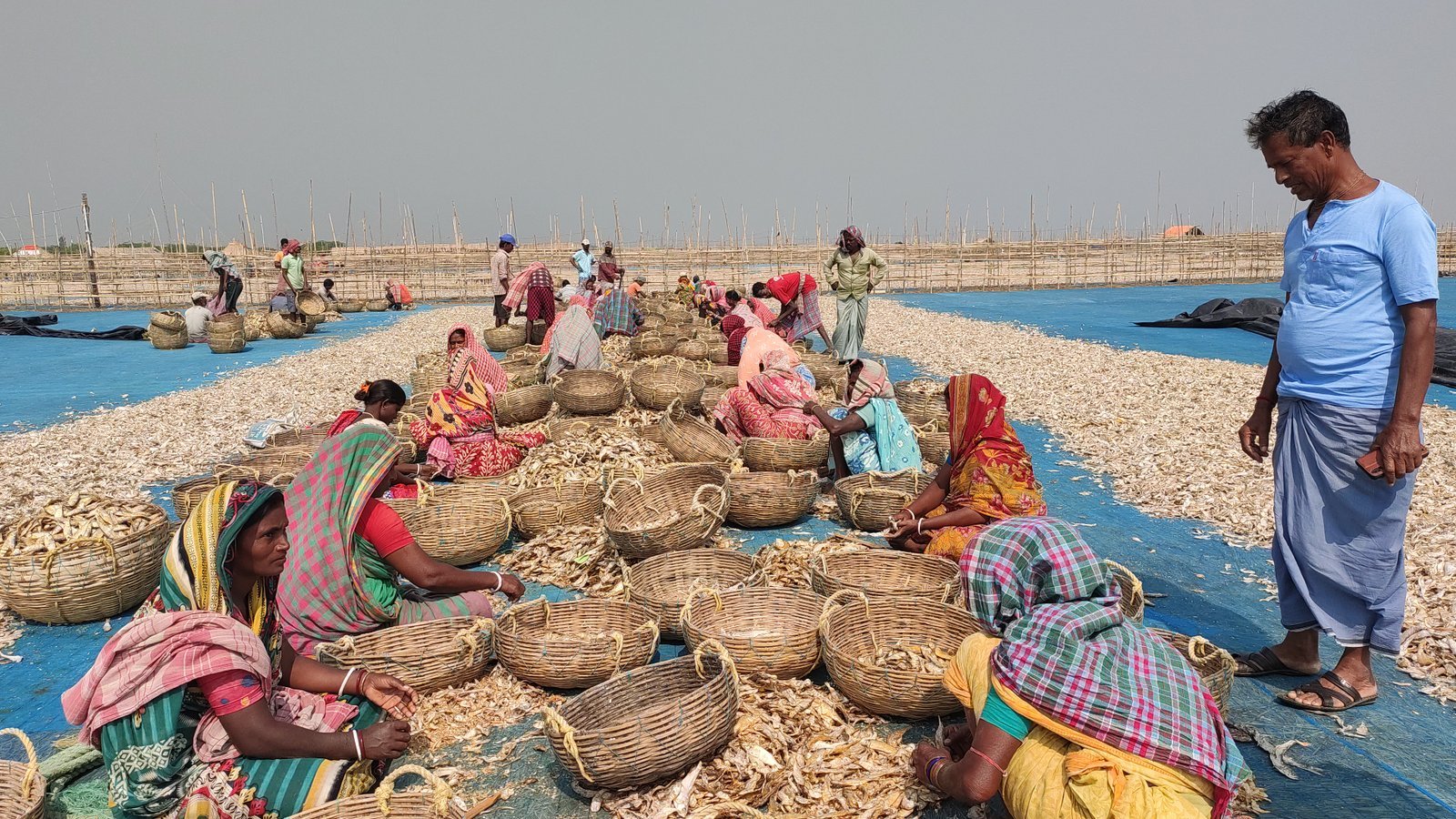
Fish is an important part of the diet of the people in West Bengal, and the state ranks first in fish consumption in India. For generations, fish drying in West Bengal has been an essential source of livelihood for thousands. The major wholesale markets for dried fish in the state are Territory Bazaar in Calcutta and Uluberia in Howrah district. Winter bag net fishery in Hoogly River is the major contributor to the dried fish production. Most of the dried fish produced in the state is sold to the hilly areas of West Bengal, Assam and Tripura.

Women fishworkers sorting dried fish in West Bengal (Photo: Raktima Ghosh)
Assistant Professor, Humanities and Social Sciences, IIT Kharagpur
PhD candidate, IIT Kharagpur
Assistant Professor, Humanities and Social Sciences, IIT Kharagpur
Professor, Humanities and Social Sciences, IIT Kharagpur
Associate Professor, University of Waterloo
PhD Scholar, University of Waterloo
The Indian Institute of Technology, Kharagpur is a pubic engineering institution established by the government of India, in 1951. It is recognised as an institute national importance by the government of India. It has 19 departments, 10 centres and 8 schools, teaches UG, PG and PhD courses and has more than 12,000 students and 700 faculty staff. The Department of Humanities and Social sciences at IIT Kharagpur is a multi-disciplinary department with 28 faculty members drawn from Economics, Sociology, History, Psychology, Communication, Philosophy and Cultural Studies. The Rekhi Centre of Excellence is another multi-disciplinary centre with 12 faculty members at IIT where the primary focus is to explore the constructs of happiness and well-being in various individual and community contexts.
ICAR-CIFRI is a research organisation located at Barrackpore, Kolkata. It is a part of Indian Council of Agricultural Research (ICAR). The Institute strives for knowledge-based management of inland open waters for sustainable fisheries, conservation of aquatic biodiversity, integrity of ecological services and to derive social benefits from these waters. The major objectives of this institute are; to carry out basic, strategic and applied research for sustainable management of inland open water resources, to develop protocols for productivity enhancement in reservoirs and wetlands and aquatic ecosystems health management, and to contribute towards human resource development through training, education and extension. ICAR-CIFRI will play a major advisory role in the DFM project, besides undertaking survey research and pilot projects. It would also be an invaluable partner in disseminating the findings of the project to the various government agencies involved in fisheries development and promotion.
The School of Environment, Enterprise and Development at The University of Waterloo’s involvement will be led by Dr. Pradeep Nayak . He will be co- directing (along with Indian Institute of Technology, Kharagpur) the West Bengal Research Group of Dried Fish Matters Project and will be a lead member of the India Working Group. He is a core team member and provide leadership to the objective working groups based on his expertise in Environmental Geography. In addition, he will facilitate knowledge mobilization activities and provide leadership to the process of building a network of appropriate organisations to study dried fish value chains specifically in West Bengal and North-Eastern India.
Pradhan, S. K., Nayak, P. K., & Haque, C. E. (2023). Mapping Social-Ecological-Oriented Dried Fish Value Chain: Evidence from Coastal Communities of Odisha and West Bengal in India. Coasts, 3(1), 45–73.
Ghosh, R., Mukherjee, J., Bandyopadhyay, A., Chatterjee, S., Choudry, A., Ghosh, P., Pathak, S., Sen, A., & Sinha, P. (2023). Analyzing scenarios and designing initiatives toward just transitions: Coproducing knowledge with(in) the dried fish sector in the Indian Sundarbans. Frontiers in Water, 5. https://www.frontiersin.org/articles/10.3389/frwa.2023.1043628
Bandyopadhyay, A., Ghosh, R., Mukherjee, J., & Pathak, S. (2023). From the shabars of the Indian Sundarbans: Everyday empirics through photography. Coastal Studies & Society, 0(0), 1–17. https://doi.org/10.1177/26349817221107301
Ghosh, R. (2021, July 29). Ethos of a sinking space: Fishers in Sundarbans surmount tiger attacks, bureaucracy to earn livelihoods. Down to Earth.