
Sri Lanka

DFM Sri Lanka

Sri Lanka is a small island in the Indian Ocean with a total land area of 65,510 km2 and a 1,760 km long coastline. With the declaration of the exclusive economic zone (EEZ) in 1976, the Government of Sri Lanka obtained sovereign rights over an ocean area of 536,000 km2. The fisheries sector in Sri Lanka is basically small-scale, but is very important in terms of employment, food security and generation of foreign exchange. Fish products are a vital source of animal protein, providing around 70% of the animal protein consumed in the country.

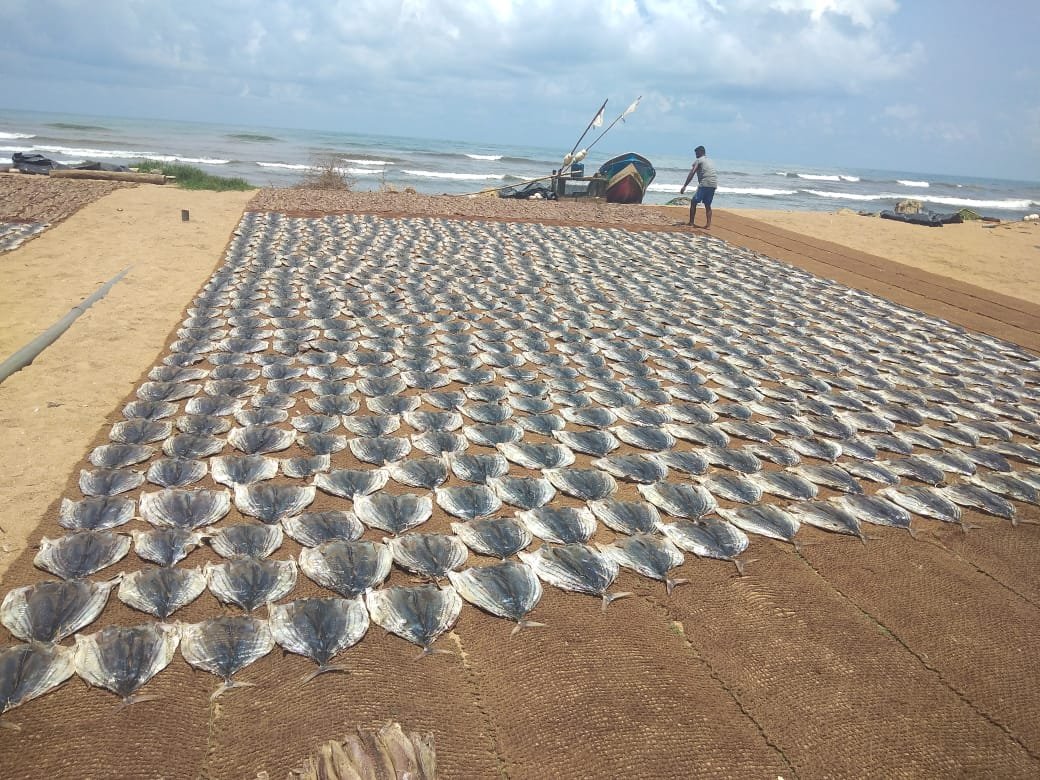
Dried fish has been produced in Sri Lanka for centuries, with British-era records noting both local production and its trade to South India, though colonial fish and salt taxes and the rise of the fresh fish industry contributed to its early decline. Since the 1990s, however, dried fish production has expanded significantly: MFARD reports that its share of total fish production rose from 5.1 percent in 1995 to 12.2 percent in 2016, with domestic production increasing from 21.1 percent to 65 percent of national supply. Production is concentrated in Trincomalee, Mannar, Puttalam, Matara, and Jaffna, with about 70 percent coming from the Northern and Eastern provinces; imports supplement supply from countries such as Thailand, India, Indonesia, Pakistan, the Maldives, and China. The dried fish sector plays multiple roles: preserving surplus catch, providing income and alternative livelihoods for fishing households and especially women, supplying protein to rural and estate communities, and ensuring year-round access to fish. Its value chain spans fishers to processors, traders, wholesalers, and retailers. Yet the sector faces serious challenges, including concerns over poor product quality, exploitative and hazardous working conditions for women, chemical use in drying and storage, inadequate sanitary practices, fluctuating fish availability, growing demand for fresh fish, and competition from international trade, all of which threaten the affordability and accessibility of this key protein source for poorer households.

Galappathhi et al image

Dried fish processing in Sri Lanka (Photo: Madu Galappaththi)

Team Members

Contributors

Mr. Upul Liyanage

Researcher

Mrs. Renuka Weerakkody

Researcher

Dr. Ranjith Wickramasinghe

Researcher

Mr. K. Suraj Chandra Kumara

Researcher

Partner Organizations

University of Ruhuna

The University of Ruhuna is a public university in Matara, Sri Lanka, and the only university located in Southern Sri Lanka. The University is organised into ten faculties (Faculty of Agriculture, Faculty of Engineering, Faculty of Fisheries and Marine Sciences and Technology, Faculty of Humanities and Social Sciences, Faculty of Management and Finance, Faculty of Medicine, Faculty of Science, Faculty of Graduate Studies, Faculty of Allied Health Science, and Faculty of Technology) throughout the Southern province of Sri Lanka. The University undertakes research, mostly with other universities, government organisations, semi-governmental organisations and non-governmental organisations. The research is funded by both Sri Lankan and foreign entities.

Hector Kobbekaduwa Agrarian Research and Training Institute (HARTI)

Hector Kobbekaduwa Agrarian Research and Training Institute (HARTI) is the premier national institute in the field of socio-economic research. It generates a range of policy analysis to cover key determinants of human and research development in the agrarian sector, functions under the Ministry of Agriculture. HARTI collects daily and weekly food prices from identified locations in Sri Lanka thus serves as the data bank for agrarian research and policies. The institution has granted its consent to work as a collaborative partner for the DFMSL project together with University of Ruhuna.

Significant Publications

  • Koralagama, D., Wickrama, S., & Adikari, A. (2021). A Preliminary analysis of the social economy of dried fish in Sri Lanka (Working Paper No. 06; Dried Fish Matters). Dried Fish Matters / University of Ruhuna.
  • Bandara, V. G. S. P. (2021). An Assessment of Marine Dry Fish Industry in Sri Lanka [Undergraduate Thesis]. University of Ruhuna.
  • Amarasinghe, O. (2020). Key Zone Identification: A Study to identify the key dry fish producing zones in Sri Lanka (Working Paper No. 02; Dried Fish Matters). Dried Fish Matters / University of Ruhuna.

  • Amarasinghe, O. (2020). National Policies & Regulations on Dried Fish in Sri Lanka (Working Paper No. 03; Dried Fish Matters). Dried Fish Matters / University of Ruhuna.

  • Amarasinghe, O. (2020). Development Interventions related to Dried Fish in Sri Lanka (Working Paper No. 01; Dried Fish Matters). Dried Fish Matters / University of Ruhuna.

  • Gunawardena, M. U. N. (2018). Gender equity and equality in dry Fish processing: A case of Southern coastal region in Sri Lanka [Undergraduate Thesis]. University of Ruhuna, Matara.