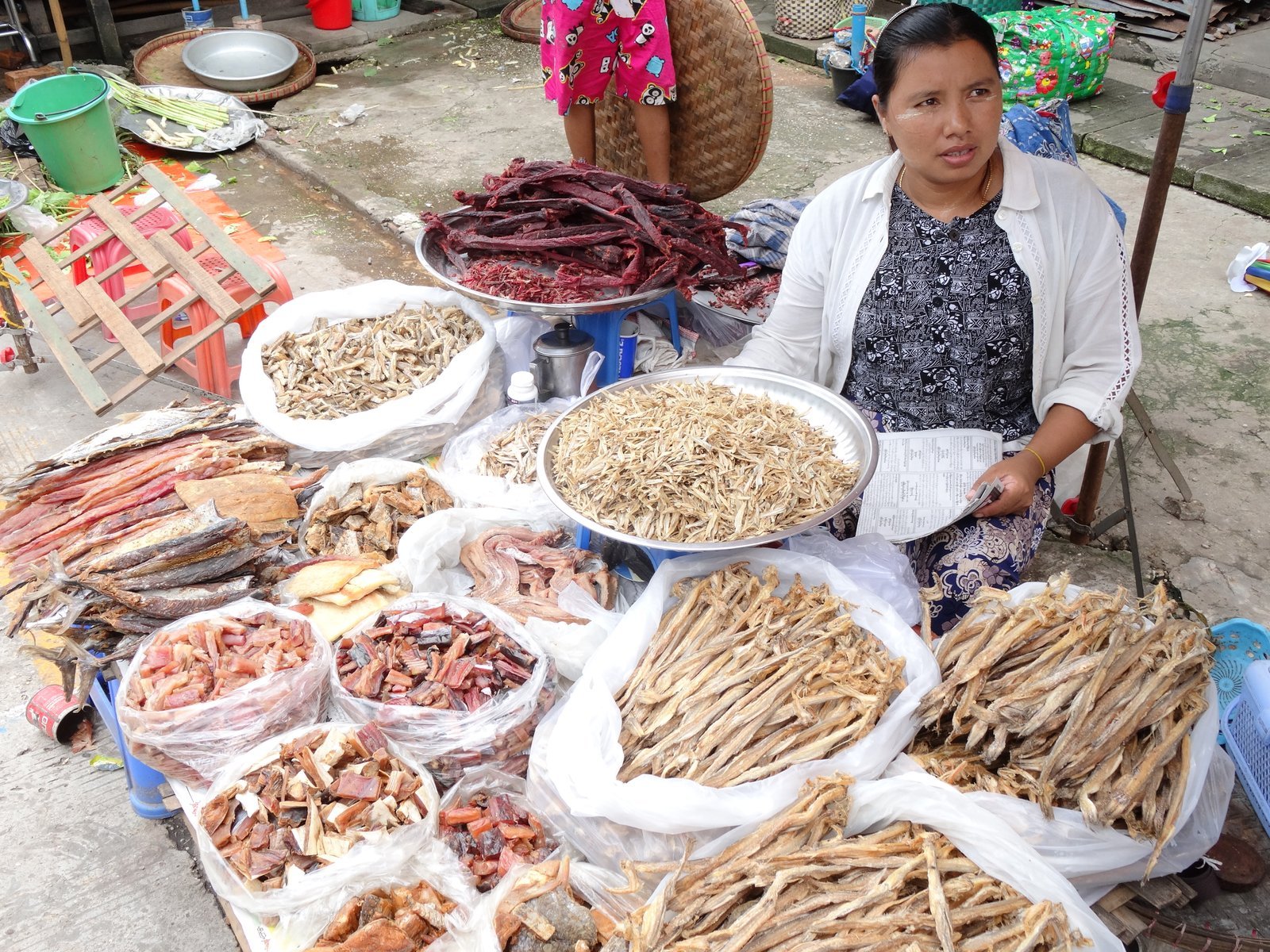
Myanmar (formerly Burma), is a country in Southeastern Asia, bordering the Andaman Sea and the Bay of Bengal, between Bangladesh and Thailand. It has a coastline of 1,930 km. The majority of Myanmar’s population is rural, with the density of settlement in each region related to agricultural production, particularly of rice. Although city populations have been growing, the pace of urbanization has not been as rapid in Myanmar as it has been in most other countries of Southeast Asia.
In common with many of its neighbours in Southeast Asia, rice and fish are key staples in Myanmar. Fish, commonly small fresh fish, dried fish, fish paste and fermented fish products from inland are considered as the major animal protein sources and, have observed to exceed other animal protein sources such as meat and eggs in local markets by a factor of 10:1. Fish paste and dried fish are mostly produced in coastal regions in Rahkine state and Tanintharyi region in Myanmar. Myanmar’s dried fish are mainly exported to India, while the other marketable fish are being exported to China, Thailand, Singapore, Kuwait, Malaysia, Saudi Arabia, Japan, Bangladesh and the United Kingdom.

Network Actions Group
Wildlife Conservation Society, Myanmar Program
Associate Professor, Michigan State University
PhD candidate, University of Manitoba
Masters student
Masters student
Network Activities Group (NAG) is a registered and non-profit and non-government organization in Myanmar, established in 2008, and proactively engaging in improving fisheries governance in all delta and coastal areas of Myanmar. NAG has physical coverage of 12 states/regions out of 14 states/regions with 25 project offices.
WCS has been working in Myanmar for over two decades and operates through MoUs with the Ministry of Natural Resources and Environmental Conservation and the Ministry of Agriculture, Livestock and Irrigation (Department of Fisheries). They have developed strong ties with local partners, developed a suite of pilot projects (in southern Rakhine State, with others emerging in Mon State and Ayeyarwady and Tanintharyi Regions), and committed ourselves to working with partners to secure new data and knowledge to inform sustainable fisheries co-management. Together with Michigan State University, WCS anticipates playing a leadership role in the DFM project including serving as a member of the Myanmar country-level working group.
Zu, A. M. (2023). ASSESSING THE IMPACTS OF TRIPLE CRISES ON THE MEN AND WOMEN OWNED SMALL-SCALE DRIED FISH PRODUCTIONS: A CASE STUDY IN AYEYARWADY REGION, MYANMAR. Asian Institute of Technology.
Synt, N. L. K. (2023). Gender analysis of dried fish consumption among Myanmar migrants in Mahachai Subdistrict, Samut Sakhon Province, Thailand. Asian Institute of Technology.
Aung, M. Z. (2023). Gender Analysis of Micro and Small-scale Dried Fish Business in Ayeyarwady Region, Myanmar. Asian Institute of Technology.