Karnataka, the largest state in South India, is a region where diverse landscapes, from the Western Ghats to a 320-km Arabian Sea coastline, shape both its ecology and livelihood systems. Although it is primarily an agricultural state, Karnataka also has a significant marine and inland fisheries sector, ranking as the fourth-largest fish producer in India with an annual output exceeding 600,000 metric tonnes, making fisheries a vital complement to farming-based rural economies. Along its coastal districts of Dakshina Kannada, Udupi, and Uttara Kannada, traditional fishing communities, especially women engaged in post-harvest processing such as drying, curing, and marketing, play a critical role in sustaining local food systems and low-cost nutrition. These small-scale, community-based fisheries coexist with pressures from mechanized fleets, climate variability, coastal development, and competition for marine resources, positioning Karnataka as an important case for understanding how traditional coastal economies adapt within broader processes of modernization and environmental change.
Dried fish plays a vital role in coastal food systems and rural diets, serving as an affordable source of micronutrients and protein, particularly for poorer communities in regions beyond the coast. Despite its nutritional and economic importance, the dried fish sector in India and along the Karnataka coast in particular faces multiple challenges across both demand and supply dimensions. On the demand side, dried fish is increasingly perceived as a non-aspirational and unhealthy food, largely due to its high salt content and inconsistent quality. Rising incomes and the growing availability of fresh or processed fish alternatives have further reduced its appeal and consumption. Declining and unstable supply has also contributed to its waning presence in local diets.

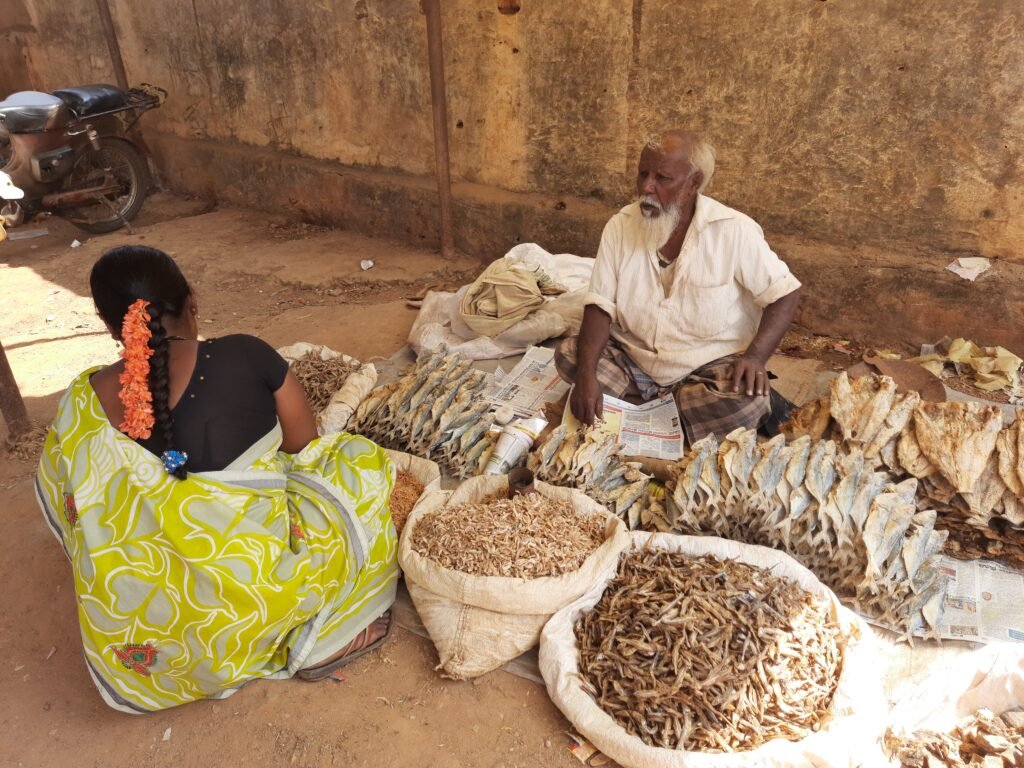
A dried fish retailer in Haveri, Karnataka (Photo: Prashanth Ramappa)
Professor of Development Studies, Azim Premji University, Bengaluru
Amalendu Jyotishi is a Professor at the School of Development, Azim Premji University. He has a PhD in Economics from Institute for Social and Economic Change, Bangalore through the Bangalore University. Prior to joining Azim Premji University, he has worked in the Amrita School of Business, Ohio University Christ College Academy. He has also worked in a few social sciences research institutes including Gujarat Institute of Development Research. His research interests cover a wide range of issues relating to institutional economics aspects of agribusiness, water markets, forestry, inland fisheries and livelihood issues in varied ecosystems.
Professor of Fisheries Economics (Retired), College of Fisheries, Mangalore
Ramachandra Bhatta is a fisheries economist who served as a faculty at the College of Fisheries in Mangaluru for 40 years before retiring in 2015. His interests include economics of marine and coastal resources, coastal conservation planning, and sustainable livelihoods.
Research Scholar, DFM Karnataka
Prasanna Surathkal is a research associate at the Azim Premji Foundation, Bengaluru, India. He is trained in fisheries sciences and agricultural economics. His interests include fisheries economics and data analysis.
Research Scholar, DFM Karnataka
Established in 2010 through the Azim Premji University Act of the Government of Karnataka, Azim Premji University is recognized by the University Grants Commission (UGC) under Section 2F. Sponsored by the Azim Premji Foundation, the University’s mission is to contribute to a just, equitable, humane, and sustainable society through education, research, and policy engagement. Its objectives include preparing socially committed graduates, advancing knowledge in education and development, strengthening the education and development sectors through continuing education, and influencing policy and practice in these domains.
The Snehakunja Trust is a non-profit charitable organization dedicated to facilitating, promoting, and executing holistic health, rural development, environmental advocacy and conservation of coastal and Western Ghat diversity. The Snehakunja Trust was established by visionary philanthropist and a surgeon Dr. Kusuma Sorab (1937-98) as a charitable trust to provide quality community health services at affordable cost. Under her eminent leadership the Vivekananda Arogyadhama was built to serve the health care needs of the community. While our historical roots (established in 1976) were founded in the field of ayurvedic health, we recognize that conservation of livelihoods require an integrated approach and linkages with markets, credit and natural resources.
Surathkal, P., Jyotishi, A., Bhatta, R., Scholtens, J., Johnson, D., Mondal, G., & Gupta, P. (2023). Implications of utilization shifts of marine fish in India: A macro-level empirical analysis. Reviews in Fish Biology and Fisheries, 33(3), 767–783. https://doi.org/10.1007/s11160-022-09752-5
Ramappa, P., Surathkal, P., Jyotishi, A., & Bhatta, R. (2023). P. Ramappa, P. Surathkal, A. Jyotishi and R. Bhatta, “Mapping the Dried Fish Markets of Karnataka,” 2022. (Dried Fish Matters Working Paper No. 12; p. 46). Snehakunja Trust / University of Manitoba / Azim Premji Foundation.
Jyotishi, A., Surathkal, P., & Bhatta, R. (2023, April 13). Tragedy of the commons: In Karnataka, small-scale fishers are losing their foothold. The News Minute.