Gujarat is a state on the western coast of India with a coastline of 1,600 km (990 mi) which accounts for 19.70 percent of the total coastline of the country and about 46 percent of the western coastline of India. It is the sixth largest Indian state by area and the ninth largest state by population. Gujarat is bordered by Rajasthan to the northeast, Daman and Diu to the south, Dadra and Nagar Haveli and Maharashtra to the southeast, Madhya Pradesh to the east, and the Arabian Sea and the Pakistani province of Sindh to the west. Its capital city is Gandhinagar, while its largest city is Ahmedabad. Fisheries play a significant role in the income, employment, livelihoods, and food security of the people of Gujarat. According to the Government records and statistics, a large proportion of fishers are directly dependent on the marine fishery sector for livelihoods, while many of them are engaged in small-scale fisheries using both traditional and motorized fishing crafts.
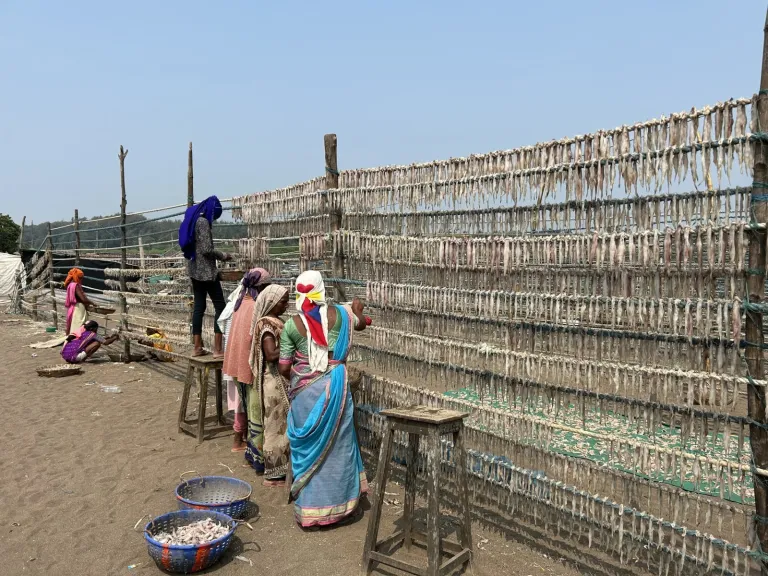
Dried fish processing is a common practice of Gujarat coastal region. About 20 percent of the fish harvest is being processed regularly for domestic and overseas consumption. Totally, 11 export units and 350 domestic dried fish units are involved in dried fish processing in Gujarat state. The state accounts for about 80 percent of total dried fish exports from India per season. Bombay duck (Harpodon nehereus), ribbon fish (Lepturacanthus savala), shrimp (Parapenaeus stylifera), cat fish (Arius maculatus), leather jacket (Aluterus monoceros), silver bellies (Gerres subfasciatus), anchovies (Stolephorus indicuse), soles (Cynogolssus macrolepidotus, Paraplagusia bilineata) and horse mackerel (Trachurus japonicus) are some of the common species processed in Gujarat coastal region for dry fish production.

Fish drying yard in Nargol, Gujarat – India (Photo: Mohammad Anas Shoebullah Khan)
DFM Gujarat Lead
Dr. Tara Nair is a prolific researcher with decades of experience across livelihoods and labour, rural finance, and gender. She holds an M.Phil. and Ph.D. in Applied Economics and Economics, respectively, from the Centre for Development Studies, Trivandrum (Jawaharlal Nehru University, New Delhi). Dr. Nair has previously served on the faculty of the Gujarat Institute of Development Research (GIDR), Entrepreneurship Development Institute of India (EDII), Mudra Institute of Communications Ahmedabad (MICA), and Institute of Rural Management Anand (IRMA). She has also headed research at the Friends of Women’s World Banking (India).
Associate Professor, The University of Winnipeg
Dr. Kirit Patel’s teaching, research, and community engagement focus on food security, environmental justice, and community empowerment. His research examines socioeconomic and environmental issues related to environmental justice, nutrition security, rural–urban migration, biodiversity conservation, indigenous knowledge systems, and the governance of common property resources in the Global South. Over the past eight years, Dr. Patel has raised nearly four million dollars for research projects and actively engages undergraduate and graduate students in his work.
Project Manager, Dried Fish Matters
Mr. Mohammad Anas Shoebullah Khan is the Project Manager of the Dried Fish Matters Project and is also a researcher with the Gujarat team. His work focuses on coordinating research and field activities across partners and aligning project implementation with DFM’s broader thematic goals.
Gujarat Institute of Development Research (GIDR)
Ms. Oza leads documentation and knowledge management for the DFM Gujarat team, ensuring systematic organization of field data, reports, and research outputs.
The University of Manitoba, Canada
Prof. Derek Johnson provides overall guidance to the DFM project. He supervises master’s, doctoral, and post-doctoral scholars working under DFM’s multi-country research initiatives, bringing extensive expertise in fisheries governance, livelihoods, and social-ecological systems.
The University of Winnipeg, Canada
Dr Alan Diduck is Professor Emeritus at the University of Winnipeg, Canada.
Gujarat Institute of Development Research (GIDR)
Dr. Mishra was closely involved with both field research and analysis within the DFM Gujarat team during the scoping research phase, contributing his expertise in applied social science research and development studies.
Ahmedabad University
Dr. Baxi collaborated closely with the GIDR team across all research components of DFM Gujarat, contributing to interdisciplinary analysis and academic outreach.
University of Ahmedabad
Dr. Sara Ahmed provided overall guidance to the project during the scoping research phase. Her work focuses on gender, water governance, and social inclusion
Established in 1970, GIDR is a premier social science research institute in India supported by the Indian Council of Social Science Research, New Delhi and the Government of Gujarat. The institute’s current research priorities include issues such as agrarian transformation, sustainable livelihoods, climate risks and local adaptation strategies, innovation and informal production, local-global integration and role of standards, and provisioning and access to basic infrastructure. Much of the research at GIDR is based on careful empirical research at the micro level, while a good part directly informs national and regional policies. GIDR played an important role in Phase 1 of DFM research in Gujarat, leveraging its critical strengths in organizing and executing large-scale primary research, including a team of well-trained and committed research associates.
Aajeevika Bureau is a non-profit organization based in Rajasthan, India, dedicated to improving the lives and livelihoods of rural migrant workers. Established in 2005, the trust provides identity services, skill development, legal aid, financial inclusion, and social security support to migrant labourers working in informal sectors across India. Through its field centres and partnerships, Aajeevika Bureau promotes dignified migration, fair labour practices, and the recognition of workers’ rights within India’s internal migration economy.