Cambodia is a country located in the southern part of the Indochina peninsula in Southeast Asia. It is 181,035 square kilometers (69,898 square miles) in extent, bordered by Thailand to the northwest, Laos to the northeast, Vietnam to the east and the Gulf of Thailand to the southwest. With permanent and seasonal wetlands covering 30% of the land mass of the country, Cambodia has one of the largest and most diverse fresh water fisheries, following geographically much larger China, India and Bangladesh. While the contribution of the marine sub-sector to the fisheries sector has increased over the years, the fresh water sub-sector continues to strongly dominate fisheries in Cambodia, with most of the fishing activities taking place along the Mekong basin and in the Tonle Sap Lake. Fish is a traditional staple in the Cambodian diet and vital to nutrition and food security of the people. Cambodian fishery resources are unparalleled on a global scale, too. The country holds two world records: the highest catch of inland fisheries per capita and the highest consumption of freshwater fish per capita.
Historically, fish processing and trade have been an important part of not only the Cambodian economy, but also its rich culture and heritage, as shown by the archeological finds and the depiction of fishing scenes in the region’s ancient temples. While data and studies exclusively focusing on the fish processing sector are scarce in the Cambodian context, as a sector, fisheries provides an important livelihood for the poor. An estimated 6 million Cambodians work as permanent, temporary and seasonal employees, in both harvesting and processing activities. Post-harvest and trade is one of the three pillars, around which the strategic planning for the fisheries sector had been designed and, the plan stresses the need for improving quality and enhancing market access to processed products. A traditional and popular form of fish processing in Cambodia called Prahoc, is one of the few documented and studied fish processing practices in Cambodia. It is a form of crushed, salted and fermented fish paste made of mud fish or small sized fish. Prahoc continues to be an important condiment used in soup etc. but in poorer rural regions, it is consumed with rice.

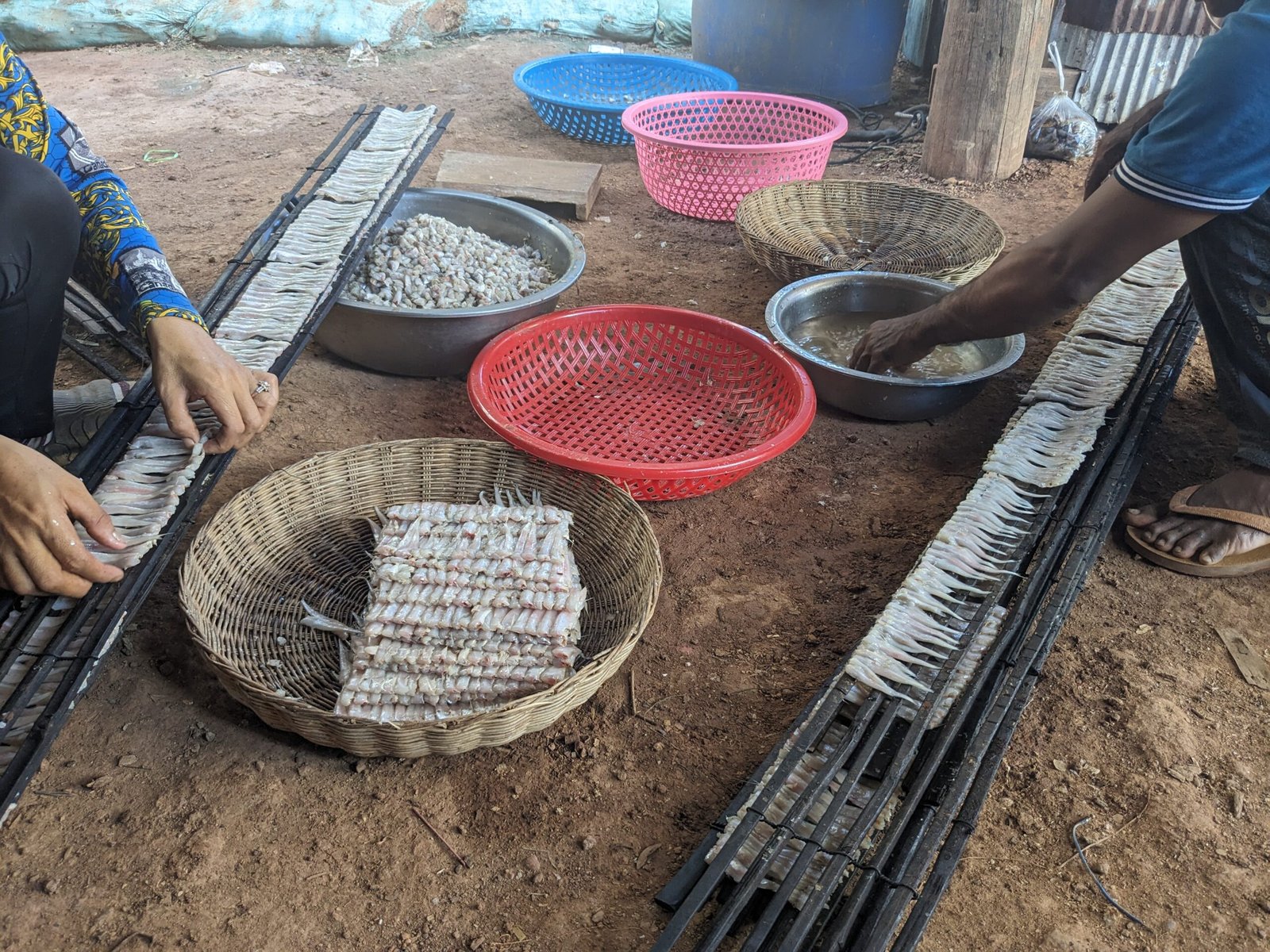
Smoked fish preparation in Kampong Khleang, Cambodia (Photo: Colleen Cranmer)
Professor, Asian Institute of Technology
Dr Kyoko Kusakabe is a professor of Gender and Development Studies at Department of Development and Sustainability, School of Environment, Resources and Development, Asian Institute of Technology in Thailand, where she is also the head of department. She has over 20 years of experience in research and teaching gender and development in Asia especially focusing on the Mekong Subregion. Aside from her academic work, she has experience in working with NGOs and government organizations for gender mainstreaming and integration of gender issues.
Founder & Director, Cambodian Institute of Research and Development
Research Associate, CPARD
Ms Uon Sokmoly is currently working as a research associate at the Center for Policy Research in Agriculture and Rural Development (CPARD) of CDRI. Before joining with CDRI, she worked as a research and training officer at Cambodian Institute for Research and Rural Development. Regarding to her previous working experiences, she used to conduct various research studies, especially in agricultural sector where she was responsible for developing research methods and tools, data collection, and draft report writing. In addition, she also experienced in working as a monitoring and evaluation officer with another development project.
Researcher, Centre for Poverty Analysis
Director for Nutrition, Health and Security, CGIAR
Dr Shakuntala Thilsted is the Director for Nutrition, Health and Food Security Impact Area Platform, CGIAR. She was awarded the 2021 World Food Prize for her ground-breaking research, critical insights, and landmark innovations in developing holistic, nutrition-sensitive approaches to aquatic food systems. She was awarded the 2021 Arrell Global Food Innovation Award for research innovation. She is a member of the Steering Committee of the High Level Panel of Experts on Food Security and Nutrition (HLPE) of the United Nations Committee on World Food Security (CFS), and Chair of the Scientific Advisory Committee (SAC) of the UN Food Systems Coordination Hub
Associate Professor, University of Ottawa
Dr. Melissa Marschke is an Associate Professor at the University of Ottawa, Canada. She is interested in human-environment relations, and did her doctoral work in Cambodia focusing on small scale fisheries and fish livelihoods. Her current research focuses on working conditions in fisheries, including an interest in work in fish processing, and Asia’s sand trade.
PhD candidate, University of Ottawa
Ms. Colleen Cranmer is a PhD student at the University of Ottawa. Her research looks at the social, economic, and environmental changes occurring in the dried fish value chain at the Tonle Sap Lake. Focusing on micro-scale female fish processors, the research seeks to understand how the dried fish economy changing, who is benefitting and who is losing, and what this means for dried fish livelihoods in the future? The research will contribute to an understanding of livelihood vulnerabilities, adaptive capacities, and policy interventions available to micro-scale fish processors threatened by the decline of the Tonle Sap Lake ecosystem and the country’s shift towards aquaculture.
The Asian Institute of Technology (AIT), which was established in 1959, is an international institute of higher learning. It is one of the Asia’s pioneer institutions contributing towards meeting the region’s growing needs for advanced learning in engineering, science, technology and management, research and capacity building. With a mission of producing highly qualified and committed professionals who will play a leading role in the sustainable development of the region and its integration into the global economy, AIT works both on natural science and social science disciplines and treasures an interdisciplinary approach. AIT is based on Thailand and has affiliated centers in other parts of the world.
CEPA is an independent, Sri Lankan think-tank promoting a better understanding of poverty-related development issues. CEPA believes that poverty is an injustice that should be overcome and that overcoming poverty involves changing policies and practices nationally and internationally, as well as working with people in poverty. CEPA strives to contribute to influencing poverty-related development policy, at national, regional, sectoral, programme and project levels. The Centre for Poverty Analysis was established in May of 2001 by nine Sri Lankan professionals working on poverty related issues. CEPA is registered as a company limited by guarantee under Sri Lanka’s Companies Act 17 of 1982, on 24th April 2001 and re-registered under the Companies Act No.7 of 2007 on 28th July 2008. CEPA carries out a range of client services that includes; research, consultancy, evaluation and training in CEPA’s thematic areas of infrastructure, migration, environment, conflict and vulnerability.
CIRD, CIRD is an independent non- governmental organization created on July 7th, 2009 by a team of qualified development specialists with diversified and extensive experiences. CIRD was fully registered as a national NGO by the Royal Government of Cambodia on Aug 11th, 2009. CIRD works directly with farmer organizations and local communities to provide capacity building and appropriate skills to ensure that rural poor people can improve their lives and livelihoods in self-determination. CIRD is a not for profit organization working with development partners and allies in Cambodia and networking globally to bring about sustainable social change.
Lokuge, G. (2021). Dried fish in Cambodia: Literature review (Working Paper No. 05; Dried Fish Matters). The University of Manitoba / CIRD.