Bangladesh

DFM Bangladesh

Bangladesh is a South Asian country. It shares land borders with India and Myanmar. The country’s maritime territory in the Bay of Bengal is roughly equal to the size of its land area. Bangladesh is the world’s eighth most populous country.  Dhaka is its capital and largest city, followed by Chittagong, which has the country’s largest port. The country’s geography is dominated by the Bengal delta with many rivers. Bangladesh is considered one of the most suitable regions for fisheries in the world, with the world’s largest flooded wetland and having the third largest aquatic biodiversity in Asia after China and India. According to the World Bank database 2017, 17 million people (1.4 million women) depend on fisheries sector for their livelihoods through fishing, farming, fish handling, and processing. 

Fish is considered as one of the main food items for Bangladeshis. As the land is a delta, Bangladesh is one of the leading fish producing countries in the world. According to the Yearbook of Fisheries Statistics of Bangladesh 2016-17 by Department of Fisheries of Ministry of Fisheries and Livestock, the total production of fish in Bangladesh is 4.134 million MT, where aquaculture contributes 56.44 percent to total production. Fish is contributing significantly towards the food security as 60 percent animal protein comes from fish. A large proportion of marine and fresh water fish landings are processed by drying, and dried fish accounted for the fourth largest share of fish consumed in Bangladesh. In some regions of the country, dried fish is consumed more frequently than any other type of fish.

Adolescent_girls_working 2

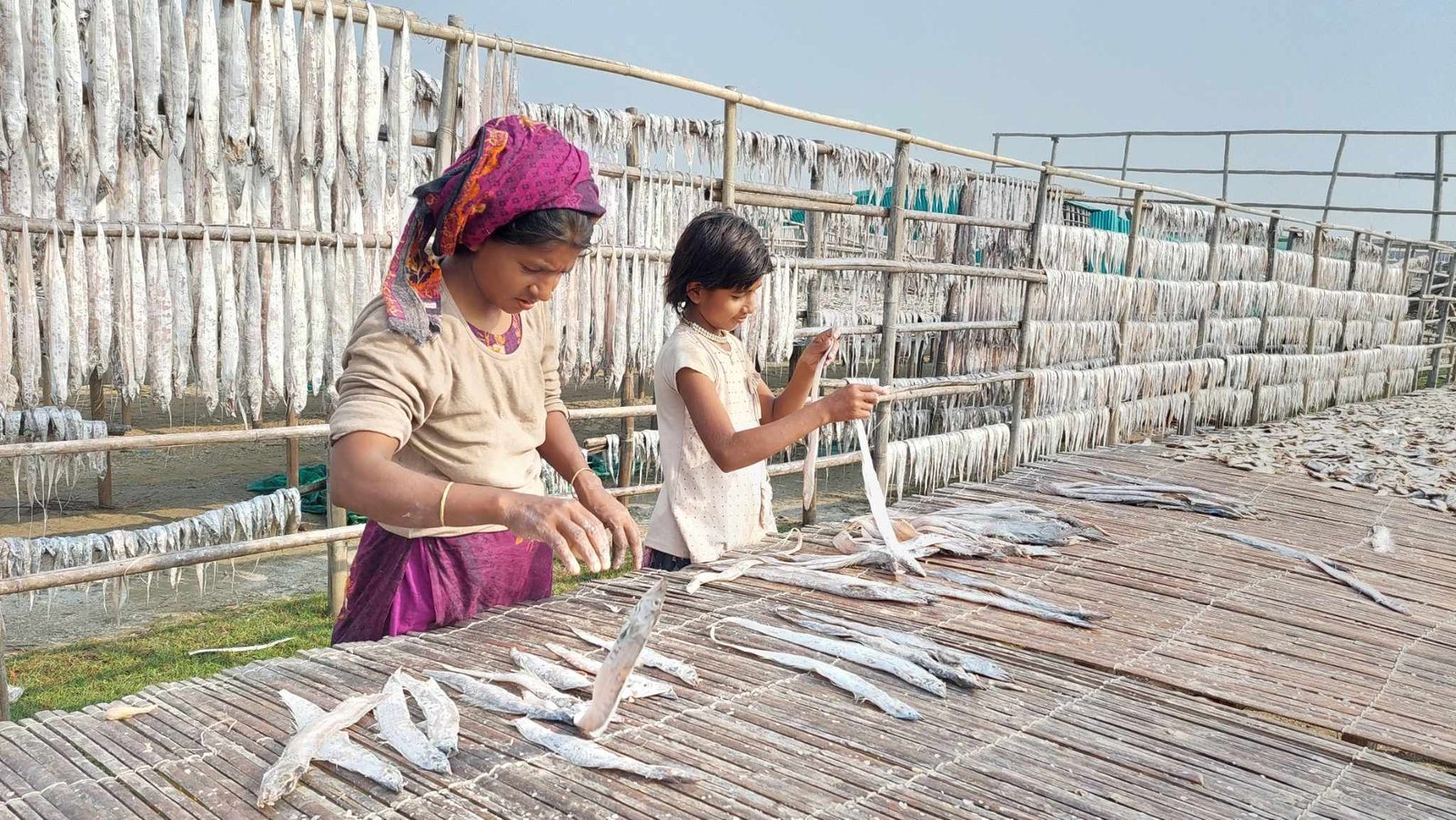
Adolescent women fishworkers in Nazirartek, Bangladesh                  (Photo: Safina Naznin)

Team Members

Partner Organizations

Jahangirnagar University

Jahangirnagar University is a public research institution located in Savar, Dhaka, Bangladesh. It was established in 1970, by the Jahangirnagar Muslim University Ordinance of the Pakistani Government. After Bangladesh gained independence, the university was reconstituted as Jahangirnagar University in 1971, under the Jahangirnagar University Act of 1973. The university is home to several research institutes, including the Institute of Business Administration, the Institute of Information Technology, the Institute of Remote Sensing and GIS, and the Bangabandhu Institute of Comparative Literature and Culture. Jahangirnagar University reserves about 50 per cent of its spaces for female students, making it the only university in Bangladesh with such a provision. The university has a Teachers-Student Centre serving as a hub for various cultural activities, seminars, and meetings. The Zahir Raihan Auditorium, named after a renowned Bangladeshi novelist and filmmaker, hosts cultural events, international conferences, and drama performances. With a history spanning over five decades, Jahangirnagar University has produced many notable alumni who have excelled in diverse fields, including the arts, science, politics, and sports. Its contributions to research and academic excellence have earned it accreditation from the Association of Commonwealth Universities and affiliation with the University Grants Commission (UGC).

Bangladesh Agricultural University

Bangladesh Agricultural University (BAU) is the premier seat of higher agricultural education and research in the country. The main task of the university is to tone up the quality and standard of higher agricultural education and to produce first-rate agriculturists, agricultural scientists and researchers for shouldering the responsibilities of agricultural development of the country. The missions of university have been to develop the art and science of agriculture for the well being of mankind, and to educate agriculturists of high standards of scientific, managerial and professional competence in harmony with the environment, and to share knowledge and skills with world partners.

Centre for Natural Resource Studies (CNRS)

CNRS (Center for Natural Resource Studies) is a pro-environmental national Non-Governmental Organization (NGO), conducting research to find solutions to the most pressing environmental, climate, humanitarian, livelihood and development challenges and acting as frontline implementing entity, striving to build social-ecological resilience in Bangladesh since 1994. Originally conceptualized in 1993, from the Bangladesh Flood Action Plan (FAP16) Environmental Study; and the formal journey started in 1994. Since formation, CNRS has drawn attention of relevant local, national and international actors including government and funding agencies through demonstrating innovations in our nature and community centric approaches and producing tangible learning outcomes. CNRS implements development and humanitarian projects in 7 key thematic areas: 1. Environment and Climate Change, 2. Food Security and Livelihood, 3. Community Development and Governance, 4. Disaster Management and Resilience, 5. Health and Nutrition, 6. Child Welfare and Protection, 7. Institutional Development

Significant Publications

  • Hasan, J., Dristy, E. Y., Anjumanara, Mondal, P., Hoque, M. S., Sumon, K. A., Hossain, M. A. R., & Shahjahan, M. (2023). Dried fish more prone to microplastics contamination over fresh fish – Higher potential of trophic transfer to human body. Ecotoxicology and Environmental Safety, 250, 114510. https://doi.org/10.1016/j.ecoenv.2023.114510
  • Hossain, M. A. R., Belton, B., & Thilsted, S. H. (2023). Fish Fermentation in the Floodplain: A Photo Essay. In E. Thrift, M. Galappaththi, R. Ghosh, D. S. Johnson, W. W. Khaing, M. Rahman, & R. Chuenpagdee (Eds.), Dried Fish Matters: Exploring the Social Economy of Dried Fish. TBTI Global.
  • Hasan, J., Islam, S. M., Alam, M. S., Johnson, D. S., Belton, B., Hossain, M. A. R., & Shahjahan, M. (2022). Presence of microplastics in two common dried marine fish species from Bangladesh. Marine Pollution Bulletin, 176, 113430.

  • Hossain, M. A. R., Sultana, M. T., Ferdous, S., Alam, Md. S., Akhtar, R., Rahman, Md. S., Shahjahan, Md., & Sumon, M. H. (2022). Key locations: Dry Fish processing and trading in Bangladesh (Working Paper No. 10; Dried Fish Matters). The University of Manitoba / Bangladesh Agricultural University / Jahangirnagar University.

  • Farook, S., Belton, B., Pendakur, K., Johnson, D. S., Haque, C. E., & Thilsted, S. (2021, November 25). Dried fish for nutrition: Change in consumption patterns and preferences, and implications towards nutrition security [Conference paper]. Session 3: Dried Small Fish: Ecology, Value Chains and Nutrition, IMBeR West Pacific Symposium 2021 “Changing West Pacific Ocean: Science and Sustainability,” Online.

  • Belton, B., Hossain, M. A. R., & Thilsted, S. H. (2018). Labour, Identity and Wellbeing in Bangladesh’s Dried Fish Value Chains. In D. S. Johnson, T. G. Acott, N. Stacey, & J. Urquhart (Eds.), Social Wellbeing and the Values of Small-scale Fisheries (pp. 217–241). Springer International Publishing. https://doi.org/10.1007/978-3-319-60750-4_10